
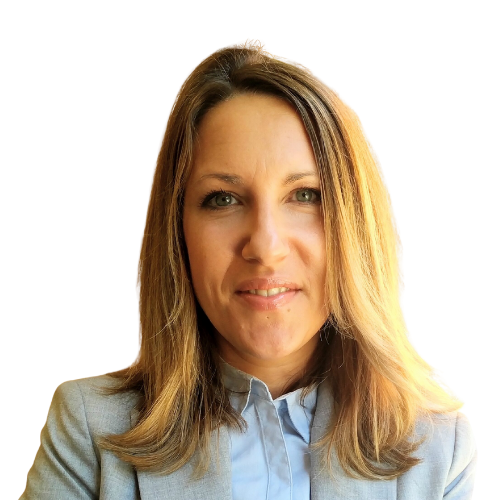
Marta Fondo is from the Open University of Catalonia (Universitat Oberta de Catalunya – UOC). She recently defended her PhD thesis around the topic of anxiety in foreign language learning and communication.
She used virtual exchanges for her research.
This is something she says she has experienced herself both as a foreign language learner and teacher.
“Many of my students are struggling with foreign language learning. But it’s not only my students. People everywhere struggle to communicate in different languages.”
The path to language anxiety research
Marta hasn’t always been a language teacher. She has a strong background in Arts and Interculturality. Her professional career began in museums and cultural centres including the Ethnologic Museum of València which explains regional and local Valèncian culture.
“I began my career,’ she says, ‘working in very multicultural environments and I became curious about this emotional reaction to speaking in another language. In museums, you are constantly communicating with people from around the world, and this enabled me to understand how important it is to be able to communicate effectively to break down perceived barriers and move beyond language itself and into intercultural communication”. At the same time, Marta was a volunteer teacher, teaching English and Spanish to migrant people in an NGO.
From that point, her path developed ‘organically’ and it was this awareness from working in museums and teaching in an NGO, brought her to her academic research focussing on foreign language anxiety and self-disclosure.
Virtual Exchange and the significance of Self-Disclosure
Marta says ‘self-disclosure’ is something we do every day.
“I’ve seen foreigners coming to me in museums and cultural centers trying to ask questions. And I see them getting increasingly anxious. I’ve been there myself when I was a student in Ireland. Although I’m a proficient speaker of English, Irish has nothing to do with English, and so I had to ask, for example, the bus driver, to help me with bus stop names and I was so anxious at not being able to pronounce the names properly.” Thus, I could not imagine the effect of this anxiety when people are not proficient or are trying to survive in a foreign country.
Marta explains how important self-disclosure is when participants participate in virtual exchanges.
“Self-disclosure is the personal information we reveal about ourselves and share with others. It is a key part of the content of the exchange. So, when students talk about their traditions, their cultures, their families, most of the content they are sharing to learn together in collaboration is pushed towards sharing this personal information. That’s what I mean by self-disclosure.
“But there is a second part in this equation regarding self-disclosure. When we socialise, we create bonds. And to create these all-important bonds, we use self-disclosure. Indeed, the first thing I did here, and you asked me to do, was talking about myself, introducing myself. So the audience gets engaged with me, and they know who I am. Who I am entails talking about myself. I’m this person, I’m from here, and so I’m sharing personal information. When we create bonds, we always share this personal information. And in a collaborative environment, such as a virtual exchange, this is a key aspect of building trust and working together.
Therefore, self-disclosure, this personal information we share in conversations, in a virtual exchange becomes two different aspects or elements and are what we need to create relationships in order to collaborate with our virtual exchange partners.
This personal information becomes part of the content and the conversation. We need to share this information regarding our own culture with our partner as part of the learning process and as part of our intercultural skills development.”
The question was to understand the effect of sharing this personal information “non-voluntarily” on learners’ emotions. Indeed, self-disclosure is a very common practice in traditional foreign language settings when learners are asked to talk about their families, holidays, hobbies, and so on.
Advantages of working at an online university
Marta says that working at an online university provided her with the perfect context for undertaking this sort of research.
When she took a postgraduate course in e-learning, she realised how isolated she felt. Suddenly all the pieces fell into place and she realised that participating in virtual exchanges was the perfect opportunity to practice new ways of doing things.
“It brings social presence to contextualize the practice. Implementing these sorts of projects and data gathering enabled me to gain an understanding of the relationship between personal information and anxiety.”
She subsequently designed a project in international management in the field of business. This required the students to be able to communicate with other cultures in English, not their native language.
“All the data gathering was done remotely without the direct intervention of any researcher, so the students didn’t have the feeling of being observed.”
As a researcher and teacher, Marta organised and coordinated everything remotely. In this way, she noticed how they interacted. She observed this occurred in a very natural way as they were not feeling observed. This, she says, was very important, as she was not interfering thus reflecting the kind of relationship-building that would normally take place during a VE.
Findings on Anxiety through VE
Marta used the Foreign Language Classroom Anxiety Scale by Horowitz et al (1986) to measure anxiety levels, and the General Disclosiveness Scale (Wheeless, 1978) to measure the tendency of students to share personal information, at the very beginning of the virtual exchange project, before the students began to interact. Using an ecological design, Marta gathered data also during task performance – right after students had finished their video calls and at the end of the project.
To track the relationship between initial levels of foreign language anxiety and self-disclosure with their perception of the environment and their behaviour during conversations, she clustered them into groups comprising low, medium and high levels.
She noticed that as the project evolved, the differences between the students began to diminish. This was noticeable after the five different sessions assigned to the students along with their respective communicative tasks.
“So, at the very beginning, I observed that they were more nervous, they didn’t really perceive the levels of self-disclosure, because they were talking like parrots, let’s say and very anxious.
That’s because in these environments, they have to communicate and don’t have options to hide behind another classmate. Or they don’t participate at all. Or if they do participate, they have to communicate, because they are one-to-one. As time went on, they started to bond with their partners, became less nervous and so the differences between the groups were not significant anymore. It all balanced out”
At the very end of the project, Marta gathered data again to learn about the experience of students in the virtual exchange and to measure the foreign language anxiety they had experienced in this particular environment. For this, she created her own tool, the telecollaborative foreign language anxiety scale (Fondo & Jacobetty, 2020) to measure anxiety as nothing else was available to monitor anxiety in these environments.
“What we’ve seen is that at the end of the projects, there’s no significant difference between the groups in terms of the anxiety suffered in this context.” This can be interpreted as a positive effect on students foreign language anxiety thanks to participating in the virtual exchange.
Anxiety and whether it’s related to the perceived language level of the students
To understand how self-perception and communication in the foreign language was related to students’ foreign language anxiety and self-disclosure level, Marta explains she took into account the ’emotional burden’ they were already carrying into the VE related to previous language learning. She did this by giving them a questionnaire after each session. It included questions about the perception of their performance. Here too, as time went on and the project evolved, the differences between all the groups began to diminish.
“Anxious students were improving how they saw themselves as foreign language speakers. Seeing that they were feeling less anxious, they perceived themselves as better communicators in their foreign language. This was a gift, because it means virtual exchanges really work.”
Even those who had higher anxiety began rating themselves better than the non-anxious speakers. Again, Marta took this as a very positive development in the virtual exchange.
Marta says VEs clearly help students feel more comfortable and to trust themselves. This in turn led to a change in perception they had of themselves as communicators.
Future research
Next, Marta says she needs to spend more time analysing further data using her method, in order to get more robust results as to the benefits of VE. She hopes to publish new articles that delve more deeply into these aspects of anxiety, the emotion surrounding self-disclosure and student perceptions of their skills in order to provide the community with more specific data and findings.
She has promised to return and tell us more in the future