
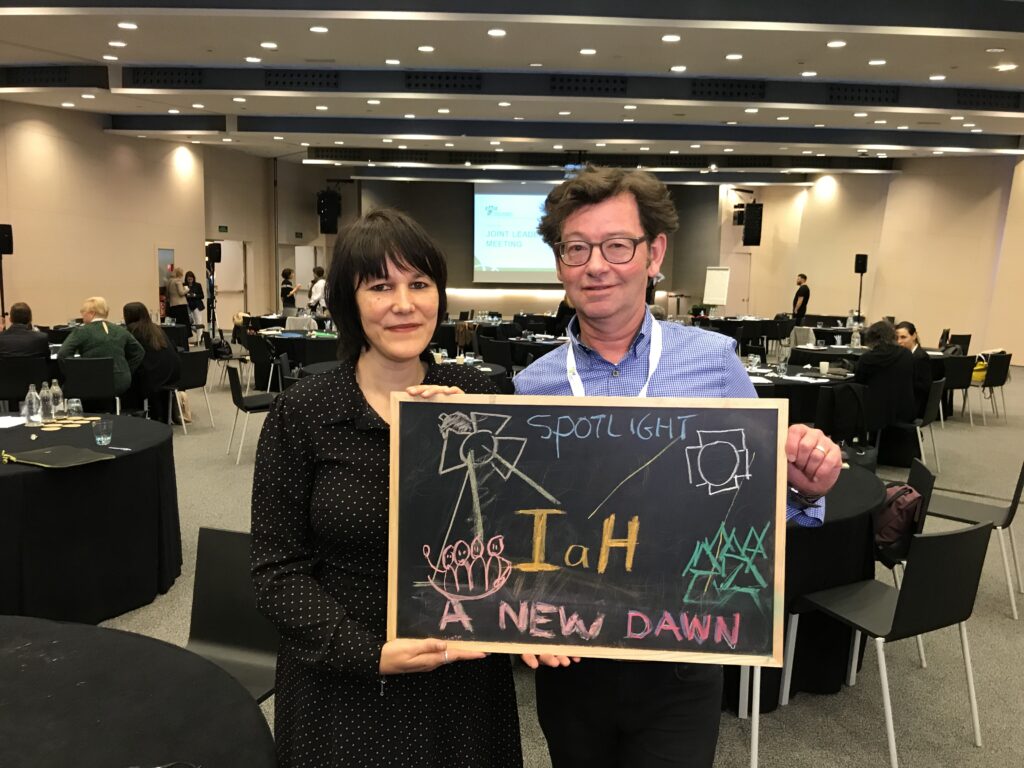
Eveke de Louw and Jos Beelen are from The Hague University of Applied Sciences, THUAS.
Eveke works at the Centre of Expertise, Global and Inclusive Learning, where she conducts research into internationalisation at home. More specifically – internationalisation according to academic disciplines. She also researches the role of educational developers.
Jos is Professor of Global Learning at THUAS and heads up the research group, Global Learning.
Together, they focus on expanding internationalisation at home through virtual exchange within their institution. They do this by conducting extensive research on the topic both within and outside of THUAS.
Their work also involves supporting lecturers in understanding how to integrate elements of virtual exchange into existing courses. By doing this, they enable them to understand the advantages of doing so. In some cases, the educators already implement this kind of strategy, but in an informal way. Jos and Eveke support the research and formalisation of the process.
What is meant by academic disciplines?
Before getting stuck in, Eveke explains that it’s important to be clear about what we mean by academic disciplines in the context of her institution. She explains these can be spaces where academics have socialised.
“So, they are linked to the subject, the content, the knowledge that they have developed and it gives them certain values as to what counts as knowledge and what is considered as good research. Not only, but also what education should be about, and what constitutes good teaching.”
In practice, she says, when focusing on internationalisation, academics will have very different views of why internationalisation may be relevant or not relevant to them, and the goals they want to achieve with that.
These are the elements that Eveke researches within her own institution. But she also takes it outside to look at what is happening in other Dutch institutions of higher education. In more practical terms, it means understanding the rationales that academics have formulated for themselves around the discourse of internationalisation.
“For example,” she continues, ” in some of the pure science programmes, educators have a tendency to believe and say that internationalisation doesn’t really mean much to them. This is because the knowledge and the work they do is considered universal. So, to clarify, a molecule is a molecule in the Netherlands in the same way as it is in China. “
Novel approaches are needed when encouraging virtual exchanges in STEM
She continues: “This means I then have to look for different ways in which I can actually engage them in talking about internationalisation. So, for them, it might be we that can identify alternative research collaborations in the field. And then I am able to explain that in order to do that, you need international collaboration and that is something they need to prepare their students for. This helps in understanding the rationales.”
Eveke says this can be a valid starting point for an initial dialogue surrounding the topic of teaching and learning and how to embed that crucial international dimension. They then begin to talk through how an international dimension can be embedded and where it may be relevant and where it makes sense.
Jos concurs and says this approach to VE/COIL entails encouraging academics to seek to work across disciplines and take an interdisciplinary view.
“We are a University of Applied Sciences,” he says, “so we look at graduate attributes. And employers find it very important that people can work across disciplines. We are of the opinion that VE/COIL is an excellent instrument to practice that and to prepare graduates for that. Therefore, we need to encourage people or convince people that they should work across disciplines.”
Getting VE and STEM to work hand-in-hand
As Reinout Klamer previously hinted, convincing lecturers to take on VE/COIL elements in their courses remains challenging. Eveke explains that various strategies are used to attempt to overcome this hurdle.
“We find our lecturers are sometimes looking for a quick fix in order to get inspired, and sometimes we are reluctant to give in to this. This is because we don’t want to copy-paste a practice from one disciplinary context to another.
However, what is maybe more effective, in our case, is that we approach academics and programme teams with a research question. So, we tell them we’re doing action research and we’re interested in what is happening in their programme. We take an inquiring approach and we know that academics love talking about their own subject,” she laughs.
The next step is to sit down with a small programme team and show them a list of possible interventions. These all belong to the internationalisation at home strategy.
“We noticed that most of the time, academics tend to have a very limited perspective of what internationalisation at home is about. Therefore, by showing some curiosity and inquiring about what they are doing in their programme can be a great way of moving forwards towards internationalisation.”
Eveke says this way enables them to understand internationalisation at home in its many facets more profoundly and also triggers some reflection in them.
“Ultimately, they are already doing a lot of what we suggest but mostly implicitly. Our strategy serves to grow their awareness and helps formalise the process. It also means that the ownership comes from them and nothing is being enforced.”
Why it’s important to support the development of Virtual Exchange
Jos explains how he and Eveke undertook a piece of research together about educational developers who support the development of internationalisation at home through supporting the design ofVE/COIL.
“We interviewed an educational developer and some lecturers because we were curious about what was discussed in the development phase and design phase of a virtual exchange.
And it turned out they talked about mainly technical things, like learning outcomes and assessment, which are very important.
But, curiously, not so much about the ‘why’: why are we doing this virtual exchange and how does it link with our other internationalisation activities?“
Jos and Eveke found this surprising that the C in COIL, the ‘collaborative learning‘ was being left out. They both consider this a crucial insight.
“We study internationalisation at home and what it means in disciplines.
And 90% of our students here at The Hague University of Applied Sciences study in Dutch.
So, then, what does it mean, and how do you enact that, when suddenly those students and academics become part of a COIL learning environment, and have to switch language and deal with different perspectives?
How virtual exchanges risk being too exclusive and why
Jos says other research demonstrates that participating in a virtual exchange project can become quite ‘exclusive’. By this, he means that the social-economic background determines whether the students grab the opportunity to work internationally or not.
“And we’re now also looking at the practice of VE/COIL and curiosity. So, what role does curiosity play? What place does VE/COIL occupy in an internationalised curriculum?
We believe that in many cases, it’s still an elective, still exclusive, and people tick a box and say, one virtual exchange done, internationalisation at home done.
This is something we need to explore further.”
Language and inclusivity or exclusivity in VE/COIL
Research shows that using English as a lingua franca can impact negatively on which students in which countries decide to participate in an international collaboration.
THUAS has taken this imbalance on board to address the tendency to partner with English-speaking countries.
Eveke says, “We have come to realise that there’s an imbalance in the relations with the students from both ends. Now, it’s safe to say we have quite a broad spectrum of partnerships. There is one particular project with five South African nations that has resulted in more than 50 collaborations with universities and partners in the iKudu project. iKudu is a capacity building project that included five European partners.
“It was super interesting as obviously the South African students would also bring in many different indigenous languages that our Dutch students were not aware of that even existed. This makes it into a very rich and also very complex learning environment.”
The advantages of doing virtual exchanges when English isn’t your first language
Jos chimes in to say that he is actually happy that English is not their first language. This is because it means greater awareness is needed when switching to English in a virtual exchange. In general, non-native speakers have to think more about what they’re saying.
“We have to think about words and terms and if you work together in a VE/COIL with, for example, a city in the north of England. There are quite some language issues to consider as the proficiency is basically inequitable. They have English as a first language. And although our English is quite okay, we still have to think about how we are saying things and which terminology we use. I actually think that is a benefit.”
Eveke agrees, adding that the online modality also offers other means of communication such as using the chat function. These other modalities can be hugely helpful when having to collaborate on complex issues in a language that’s not your own.
“You can communicate in multiple ways within the VE/COIL setup. So that’s something that I really appreciate.”
Issues with English as a lingua franca in VE
Jos adds that there is also the issue of general English and applied English in disciplines.
“So, our students do very well in talking about their favourite music, for example, which is useful in icebreakers. However, they’re not always used to using English for study-related purposes, so they often stumble over terminology. And if you introduce them to the different modalities of communication, you begin to prepare them for using that terminology in English.”