
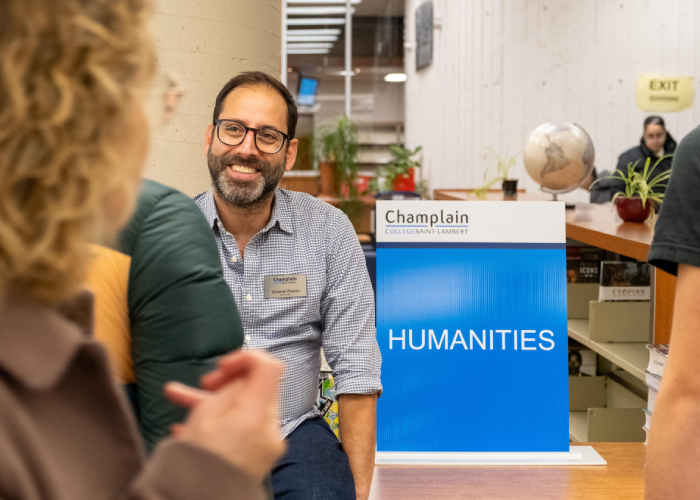
Gabriel (Gabe) Flacks is a humanities educator and has been teaching at Champlain College for 19 years.
He’s also been an enthusiastic virtual exchange practitioner for about 15 years, “before I even knew the lingo,” he laughs.
His enthusiasm for VE ultimately led to him co-founding a piece of software called Linkr, which supports virtual exchange pedagogy.
Some background to the story
Gabe is from Cape Cod, studied philosophy at McGill University. He then completed a master’s in cognitive science in California before returning to Quebec in the hope of teaching philosophy.
“I’m American-born and have lived in Canada more than half my life. There is a part of my subconscious that I think was always interested in the intercultural.”
His lightbulb moment hit when he realised that many people in the US didn’t have a clear view on what it was like to live in Quebec. Conversely, many people in Quebec felt the same about the US. He vowed to use his position at the college to open those doors.
He began getting students to blog and volunteer in an extracurricular group as he noticed how much of their lives were lived online even back in 2006.
“I arrived at the College eager to have students involved in experiential learning, through off-campus and on-campus activities and through online blogging and collaboration. But in terms of having an online audience- unfortunately it fell flat.”
At this point Gabriel wondered how he could give these students an audience for their online work.
His thought process led him to stand up at a conference he was attending and announce that he was looking for a teaching partner. He got one and in this way, an informal and accidental type of virtual exchange began to grow. At its core it had the themes of blogging and writing about experiential learning across institutions and borders.
Empowering the students
Gabriel says his focus back then was partly intercultural competency, but really about empowering students to write and feel that their work matters. He saw this early version of a virtual exchange as a way to provide that relevance.
“My students are writing, applying my course content, and then the other course students were giving feedback in a way that’s expanding their perspectives. And usually this is twofold and this intercultural aspect is what makes it exciting.
Secondly, there’s been this back and forth that happens asynchronously. My work has had collaboration in that format rather than as much synchronous. I’ve focused more on those slow, developing conversations that happen in that back and forth.”
Finding that kind of common ‘container’ and the birth of Linkr
When collaborating internationally, finding a place to store and work on documents can be challenging.
This happens because not all institutionally provided platforms and apps, like LMSes are accessible and usable by all participating students. It’s very much dependent on the rules and regulations of the country in which they study and what their institution has access to. A decade ago, Gabe began thinking about addressing this issue.
“In my first two virtual exchange experiences, I tried using existing technologies. What I was aiming for, in retrospect, or maybe in real time, was a feeling that would replicate students’ lives outside of the academic institutional software.
So, students would leave a classroom and go on to some social media, or even to a mass media site, and be able to comment and engage with that material in an interactive way.
The closest example would be Facebook, where people are constantly sharing and commenting. However, Facebook has a business model that conflicts with education, where personal data, information, and ideas needs to be protected and secured, not sold. Furthermore, advertising and marketing algorithms are not educationally appropriate.
The early days
After two flops, one where we tried to use a private social network site that doesn’t exist anymore, and one which was trying to use WordPress, my co-teacher and I realised that there were hundreds of URLs and this meant it was hard for students to find what they needed.
The original design and the birth of Linkr was to create something that had a feel of a social network with the security and privacy of educational software. This was the idea that led to the prototype. It’s been a long process of developing something that would give students the ability to easily find and collaborate with one another safely and securely, around content and material that become part of a learner’s portfolio. We want them to have this familiar feeling, but not be in an entity which owns their data.
This means that from any user, Linkr takes almost no data – just a username – which can be a pseudonym, and an email address. Our users own everything they share on Linkr and are in control of its visibility.
Features have been carefully designed to facilitate VE and COIL collaborations, with subgroups in classes and badging to enable effective learning to take place. It also recognises learners who participate in such courses as having gone beyond the standard educational experience. The instructors or the institutions create the Badges. Users who have completed the required elements to demonstrate the competency associated with the badge receive one.
Who can use Linkr
“We have a free offering, so any individual teacher can add a class, invite a co-teacher, invite students, and run a virtual exchange.
Most clients pay for a private, branded, secure network with features designed to make it easy to manage an active programme and build a thriving community.
For an organisation or an institution, if there is a VE or experiential learning programme that would benefit from a community hub which streamlines administration and engages a learning community, for that, there is a paid version. Modern in feel, but private and secure”
Gabe explains how privacy settings across Linkr are flexible and can be changed as necessary to accommodate any needs. When GDPR came into existence, they had to investigate that very closely and found that the platform was 90% compliant anyway.
“A lot of companies were hit by that but we never wanted to make that the way revenue would be generated by taking data.
So, we had to do some development work in terms of destruction of data if a user cancels their account, because GDPR compliance had a very stringent requirement in that regard. That took some development, but beyond that, we were GDPR compliant almost by design before GDPR came into being.”
Linkr is proud to be providing hubs to institutions like Green River College, hosting the Pacific Northwest COIL Center on Linkr, and organisations like the World Council on Intercultural and Global Competence and the Texas International Education Consortium. Check out www.lovelearning.org to learn more!