
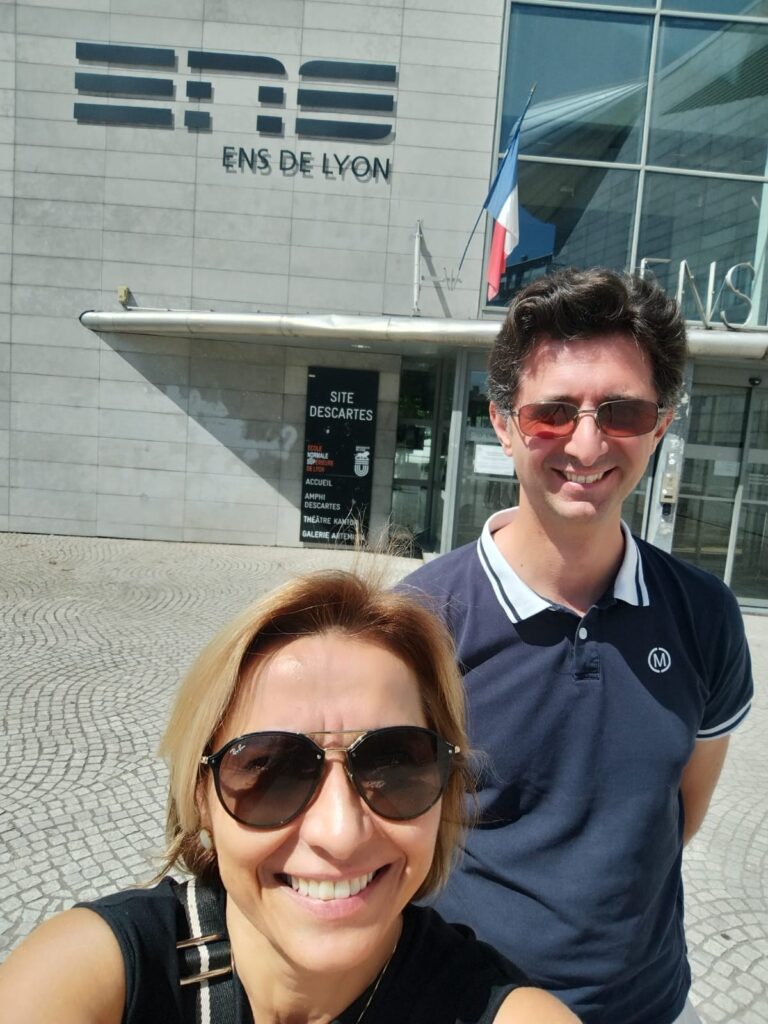
Suzi Cavalari is a teacher of English as a foreign language at São Paulo State University (campus São José do Rio Preto), Brazil and Marco Cappellini is a professor of linguistics education at the University of Lyon 1 and ICAR laboratory in France.
They’ve been effectively combining research from their respective virtual exchange projects for the past few years in a project entitled “Reasoning”.
Both Suzi and Marco share a particular model of VE which is called the teletandem model. The model involves bilingual exchanges between pairs of students where the students support and help one another with their language learning through videoconference. Brazil has pioneered this type of virtual exchange for the past two decades.
In fact, Suzi says her campus has an extensive and significant corpus of learner data as a result – the MulTeC: Multimodal Teletandem Corpus.
Marco and Suzi’s research collaboration came about as a result of a series of meetings and in-depth conversations they had at various conferences over a number of years. They discovered a shared interest in learner autonomy. This led to the realisation that they needed to share the data, combine and research it further by collaborating.
The resulting “Reasoning” research project is a Franco-Brazilian collaboration.
Learner Autonomy and Metacognition in Virtual Exchange
Marco explains: “Learner autonomy is when you push and help learners develop a reflection about how they learn. So, in our case, this happened during the teletandem model, but you can apply it to other pedagogical settings.
This push towards reflection entails the students becoming not only more aware of how they learn and what’s good for them, but also that they become more capable of taking charge of the different operations that are linked to learning. By that I mean for example, setting up objectives, choosing materials, self-assessment, and so on.
We’ve also been doing separate studies on how learners verbalise their reflection about how they learn. We deemed it could be interesting to put those strands of research together and come up with some new pedagogical frameworks.
That’s how it started three years ago.”
Suzi and Marco are now in the second year of their project where, among other things, they conducted a literature review on learner autonomy and metacognition and how these are looked at in higher education. Their research aims to contribute by exploring less studied aspects of autonomy in learning. This includes how metacognition is researched as well as emotional dimensions of learner autonomy. Marco highlights that there is a whole research team supporting the effort and not just the two of them!
“The literature on learner autonomy is vast,’ clarifies Suzi, ‘and we discerned that it is a multidimensional concept. We wanted to uncover the most under-explored aspects including the technical, political and emotional aspects. In fact, we found fewer papers on these. Therefore, we decided this was the way forward.”
The emotional aspect
Marco continues, “We delved into a couple of studies on the emotional aspect with our colleague Priscilla de Souza Ferro, who spent some time at Aix Marseille University. And it was mainly her idea to start from a very well established framework in studying emotions in second language acquisition in general, not necessarily linked to virtual exchange called CVT (Control Value Theory).”
The team then adapted the framework to the specificities of Teletandem and ran a pilot using data from learners´ diaries.
Marco says the pilot study proved that it was possible to automatize part of that analysis and he explains how Suzi’s university in Brazil, UNESP, was a pioneer of the Teletandem model, as mentioned above.
UNESP has spent the past 20 years collecting a big data set related to Teletandem that include online interactions, face-to-face video conferences and lots of diaries of learners.
“There are more than 600 pieces and this is why it is important now to find a way to automatize part of these methodological tools.
The next step in the project will be to use the tool developed by Priscilla and by us to analyse this whole data set to see what it throws up.”
Suzi says this mass of information will be analysed using a mixed approach and she hopes the analysis will reveal how the students’ emotions in learners’ diaries may relate to autonomization, which hopefully will be published soon.
The motivation to continue
“The drive’, she says, ‘is really to investigate all this data we have and promote the advancement in the area. But I really look forward to the second phase of the project as well, in which we intend to adjust the instruments we already use to foster learners’ reflections. To do this, we will look at the diaries, or the individual questionnaires, and perhaps even the orientation sessions with the teacher.
So, we are in the process of adjusting the guidance we give to students, for example, or the kinds of questions we ask in the initial and final questionnaires.
Based on these results that we have now so that we can run a second data collection.
The reason I look forward to this new phase of the project is because I think that we might have something new coming up which we can use to improve and bring some innovation to our pedagogical context as well. I think this is as important as the research.”
A word on the term ‘metacognition’.
“If the term is present in the papers, it is very rarely soundly defined,” explains Marco. “Usually, it’s like a synonym for reflection. Or you also will find ways to use that as a synonym for learner autonomy.
So, the idea is to start also from some definition of metacognition and one of my PhD students is currently in Brazil exploring this right now – so hopefully we will have some theories related to cognitive psychology and ‘reason’, hence the name of our project.
We hope these theories can be used to scaffold and to really help students foster their own reflection.“