

Jodie Birdman is part of Leuphanais scientific staff and an adjunct lecturer at Leuphana University in Lüneburg, Germany.
In the first instance, she studied teaching and education to be an English teacher in the United States. She has recently completed her PhD in Education for Sustainable Development with a focus on curriculum.
The path to virtual exchange
As part of the Digital Transformation Lab (Project DigiTaL), she was in the DigiCLIL-Exchange group. Her role was to develop and carry out a course involving a virtual exchange.
“The project is actually embedded in the Institute of English Studies at my university. It focuses especially on helping students develop their English language communication competencies while collaborating on projects.
And one of the things that we learned is, according to Erasmus reports, unfortunately, the number of students going abroad has been sinking. We also see that if they do go, it is for less time. And we know that these international experiences are so valuable and bring so much to education. This is why the DigiCLIL-Exchange team sought to create an international opportunity that takes advantage of current technology to make participation open to students who cannot or do not yet feel comfortable to take a semester abroad.
The advantages of participating in a VE
Research suggests that when people in distant locations collaborate together, it actually helps build a range of communication competencies and collaboration competencies.
For those unable to travel physically, these experiences mean students with jobs, family responsibilities, or other mobility limitations can participate without making significant life changes. Moreover, they don’t have the extra hassle of trying to find accommodation and all the other myriad challenges that come with moving abroad for a period of time.
“The challenge for me was to come up with a class before we had a partner. And that’s where we got the 17 Sustainable Development Goals. I asked myself what is something that could turn into a project out in the real world that’s going to be relevant to anyone in any location? And these 17 Sustainable Development Goals were decided on in 2015.”
The Action Plan for 2030 comes directly from the United Nations, and Jodie says this is influencing policy on the local and regional level.
This means that all UN participating nations worldwide, no matter where, will be able to find something relevant there for them. It could relate to building more sustainable cities, improving education or addressing hunger, and sustainable housing. There are many issues to choose from, says Jodie.
The starting point for the VE
Jodie wanted the virtual exchange programme to be attractive to any partner, regardless of discipline. That’s been quite a challenge! But it’s been successful and already had several iterations.
In particular, she mentions a longer than usual virtual exchange with Türkiye that lasted a full 14 weeks!
And a second one with two partners: The United States and Brazil.
She had partners in France who she says were their ‘critical friends who were able to read the outputs and give feedback on what the students were doing.
The students signed up to the programme, entitled Culture and Sustainability. It was about recognizing culture as a pillar for sustainability.
According to the IFACCA, sustainability solutions where the local culture was not considered within that solution have consistently failed (2015). For this reason, they wanted to focus on the cultural aspect of what is happening in the students’ towns.
“We asked them to go out in their neighbourhoods and take a picture of either a problem that they find interesting and use the 17 UNSDGs to help them reach a solution. It may have to do with clean air, or clean water, or reducing inequalities etc.”
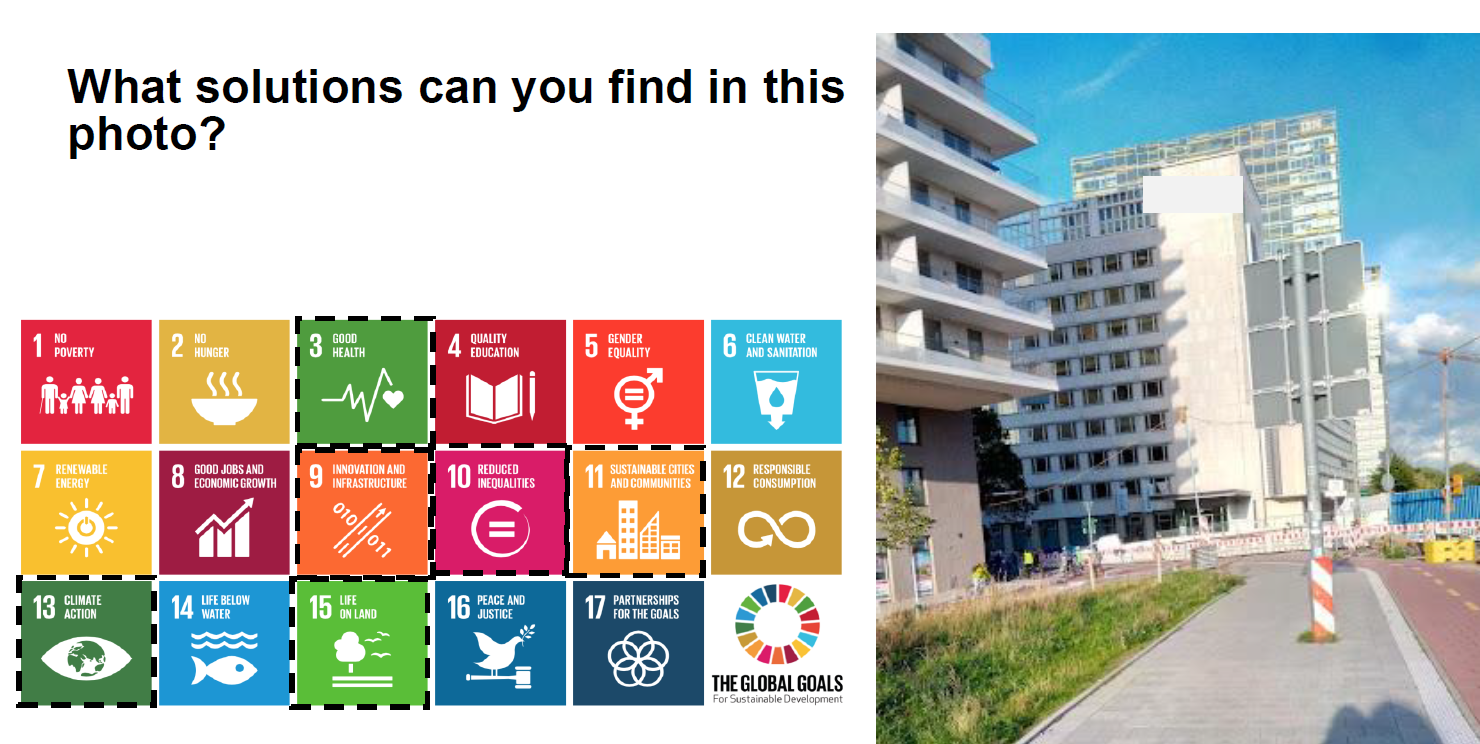
They used Padlet as a tool for displaying these pictures from the various partner country’s cities and neighbourhoods.”
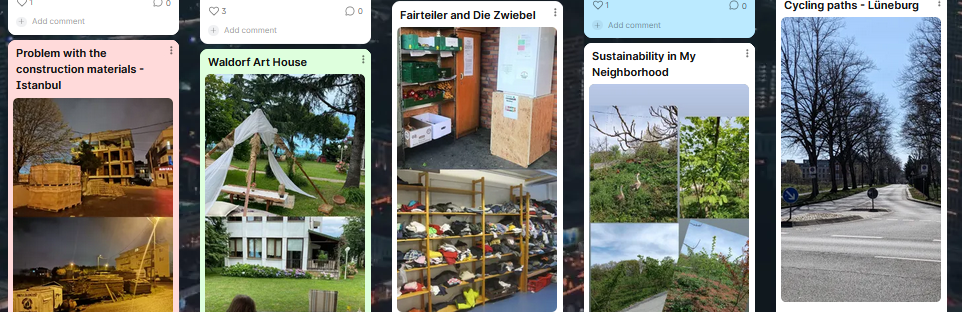
The students then worked in groups and chose one they were particularly interested in and that related to their local communities. Then they synthesised the differences based on where they were and attempted to understand how to address the problem.
An example of a sustainable issue
Every semester, explains Jodie, the students start with a case study on bike lanes. Most communities have travel infrastructure to compare.
Students were invited to consider why the bike lanes were organised the way they were and what the story behind them was. What’s the government funding behind this? What’s the social infrastructure? How did we learn how to bicycle as kids? In this way the issue became a cultural issue.
Students came across a variety of explanations and stories about bike lanes in their respective communities, some of which turned out to be ‘wicked problems’ – that’s to say, they worked in one place in such a way, but not in another. Jodie explains.
“When we talk about bike lanes in Germany or in the United States, we’re talking about eco-friendly travel and good health and all of this. But there’s a lot of pressure on countries to become modern metropolitan cities and things like that, and that means prioritizing cars. And so, in places like Trabzon, Türkiye and in Presidente Prudente, Brazil in order to build a beautiful metropolitan city, they got rid of the smaller pathways that would be relatively good for cars and bikes to share.
Then you see tension between what might be seen as progress in one place and what is seen as a step backwards in another, because, you know, it’s hilly, it’s hot. You get sweaty, why would you want to do that?”
Highlights – taking virtual exchange out into the community
Jodie says she was blown away by some of the solutions the students came up with in the first collaboration with Trabzon, Türkiye.
“We were working with future English teachers and collaborating with their English Teaching department. And the students had access to a school where they were teaching. The students collaboratively designed a game to play with school kids to help uncover their understanding and conceptualisation of sustainability.
And so, they were able to go into schools and play this game with the kids and record what the students did.”
But it didn’t end there as afterwards, they asked the kids some more questions about it, and they also took walks in the neighbourhoods around the schools to see how the kids were getting to school, what kind of infrastructure do they see, and what kind of nature do they see. And, for example, they found that the students in Türkiye had a much more social understanding of sustainability. They talked more about neighbourhoods and relationships and friends, explains Jodie.
She continues: “The students at the German schools, on the other hand, had a very ecological understanding of sustainability. And this was interesting to discern as in both cases, the children were walking to school.”
Jodie explains that from early on, children are internalising their experiences of tree-lined streets and birdsong, and playgrounds with trees and grassy areas. She found it very gratifying that her bachelors students were coming up with these ideas and learning on many different levels. Here is a link to the blog this group wrote about their experience: https://digital.web.leuphana.de/2023/11/15/seedlings-of-society/
Using VE to become citizen scientists
“Another really cool thing that just happened this last semester between Presidente Prudente and Gainesville was when the students decided to become citizen scientists and investigate air quality.
And so, they decided every day at about the same time, to check the weather app on their phones and record the air quality data where they were according to the weather app on their phones, and then compare that between the cities.”
This was an interesting collaboration, says Jodie, as graduate students from Brazil were also involved and they really helped the students with data collection.
It turned out to be a surprise on a very personal level too, as everybody assumed that Germany would have the best air quality. It turned out to be the worst.
“We’re guessing because it’s very far inland, there were no coastal or mountain winds like in the Brazilian location. In Lower Saxony, it’s pretty flat and pretty far inland, and so the air just stays where it is.”
Student feedback
Jodie says the students were made aware throughout that the sustainability aspect of their virtual exchange is about now and not something to think that someone else will do in the future.
She says they really appreciated this and understood the significance of small choices and small behaviours and how they can have a big effect.
“A big part of the sustainability plan for this is to help reduce some of that anxiety that some people have about the future, and learn to recognize all the cool things that are happening.”
Another real eye-opener for them was the idea of collaboration.
“No matter how many times we talked about time zones being different, or holidays and festivals needing to be respected, it was only when they had to figure out by themselves about document sharing for example, and other tech stuff, and how they were going to do that.”
With the three participants it was really significant, as there was the US and Germany and Brazil, so not only different time zones, but different seasons. This has a big impact on how people respond and react to situations. It proved challenging and a big learning curve when they had to coordinate between eight people and organise a meeting and collect data and share it.
“They all said they preferred collaborating in person,” she laughs. “But they all appreciated the opportunity and understood the importance of it.”
The future
Jodie explains that after COVID there was a backlash against the idea of online learning and they had to resolve this by creating a more blended environment as things were not going to go back to in-presence only.
“We began working on digitalization and began a project called DigiTaL (Digital Transformation Lab for Teaching and Learning)
Things began to change within the institution, to accommodate blended settings. Some classrooms were already equipped with cameras and microphones and this was important if we wanted to open up to the world. We have now improved blended classrooms, but for them to work effectively we need to have tech support from our institution to help set everything up in a timely manner.”
Ultimately, says Jodie, we all want to improve how we teach globally and how we use tech in a way that brings people together across divides. So communication between teachers, admin and tech staff is all important when setting up a virtual exchange so that everyone understands what is involved in this complex set up and how it all fits together.
Tech challenges in virtual exchange
“Coordinating over different data security laws in the different locations took us three semesters to get a Moodle that we could all use that wasn’t paid for through the project grant because we had to figure out how to let external students sign in to our university internal platform.”
Jodie adds that active mediation is essential from the teachers. This helps iron out all sorts of things that can cause confusion or frustration. Things such as talking time, wait time, when students perceive being talked over, or dealing with silences. It’s important to set ground rules at the start and refer back to them to deal with any conflict that arises. It’s important for students to feel listened to and heard at the end of the day.
Although her institution doesn’t run virtual exchange training, she says she was lucky enough to benefit from a training with the University of Florida, as one of the partners, and this was invaluable for her in moving forward.
Further links and information:
Digital Transformation Lab for Teaching and Learning (DigiTaL) https://leuphana.de/digital
The blogs that came out of our class: https://digital.web.leuphana.de/teilprojekte/digiclil-exchange/
Our Online Education Resources (Free and public). These include the case study mentioned above and resources for planning and delivering a virtual exchange course: https://www.twillo.de/edu-sharing/components/collections?id=2d66846b-d179-47a8-a37a-649e963e37ca