
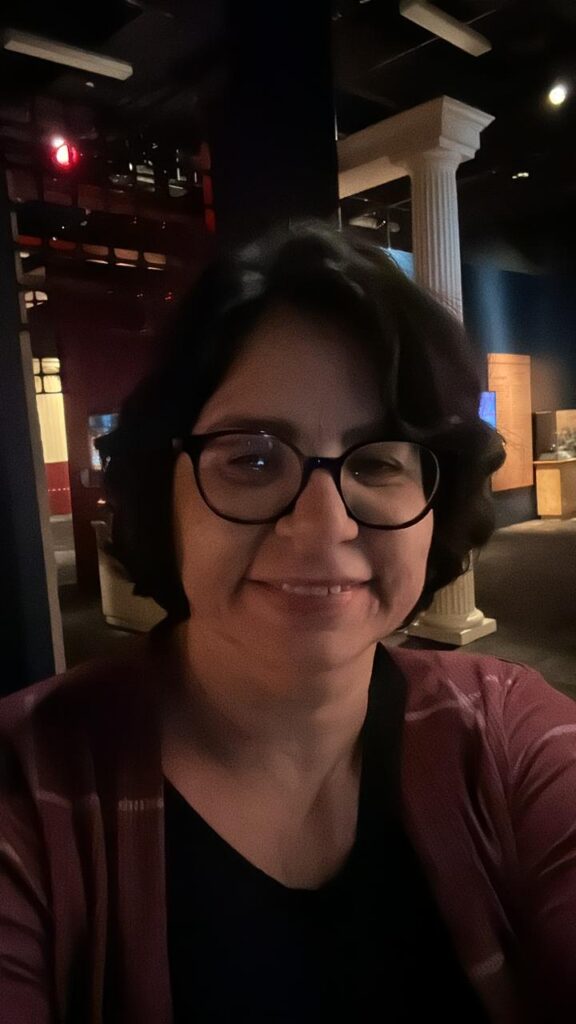
Claudia Delfino is one of the coordinators of COIL/Virtual exchange at Centro Paula Souza in Sao Paulo, Brazil.
Along with Patricia, who UNICollaboration interviewed here in October 2025, the CPS has 86 technological colleges called FATECs across the state of Sao Paulo with many COIL/VE projects ongoing within them.
“Some of our collaborations are in English. But we also do them in Portuguese and Spanish. Our newsletter is also a magazine called the Virtual Exchange Medium or VEm. It’s where we share our thoughts about virtual exchange. And it’s a place for practitioners to write about their experiences and spread the word about their work. We also use it so teachers can find partners and share the latest trends and conference findings.”
After 30+ editions of VEm, it was time to undertake some analysis and that’s what Prof Claudia Delfino has just finished. She’s a linguist and has been doing COIL/VE projects for the past four or five years.
“The work I do,’ she explains, ‘is called corpus linguistics. I decided to go for keyword analysis first of all. The aim of keywords analysis is to extract the words that are more representative of a sample of texts than they are in a bigger, reference sample.
So, what we did was: we took the first edition of VEm and compared the keywords from the following 32 editions. I looked at which words appeared with the most frequency in each edition and I made a list. We then refined our criteria to say these words had to appear in at least five editions for consistency. I had 180 texts across the 33 editions and came up with 23 keywords to analyse.
We identified five groups.”
The five groups
The first group, explains Claudia, focuses on metrics and is all about the numbers. How many virtual exchanges, how many do we deliver, the number of students etc.
The second grouping was a bit of a surprise, she says.
“Sometimes you expect the results to be a certain way, but they turn out completely differently,’ she laughs. It shows that our intuition is not always right. Most of the time, our intuition is wrong. This one appeared and we named it – the Global Collaborative International. This is mostly associated with the inclusion and circulation of knowledge. Which is actually what COIL/VE is all about, right?
The third grouping is Applied Technological Professionalism.
Because we are a technological college, the development of practical skills is valued by the teachers. Our students are about to enter the job market, so we are very concerned about the students having some practical and technical skills.
This discourse frames our COIL/VE projects as a tool for internationally oriented professional qualification, through the development of competencies aligned with labour market demands.
In this way, it reinforces the professional identity of technological programs. Within this framework, intercultural collaboration is valued primarily for its potential to enhance technical, digital, and teamwork skills. Thus, it positions COIL/VE within a logic of applied training.
And then, there’s the Humanised Professional Engagement that is mostly centred around interpersonal relations.
I think that it’s really important in the COIL/VE project that the students interact with their peers and develop their soft skills.
Finally, and for me, this is the nicest – the temporal operationalism. By that we mean the internationalisation into institutional cycles. It focuses on the months that the projects spike and when they end. And here we see certain months appearing more than others.
COIL/VE is configured as a practice embedded in temporal cycles. As a result, internationalisation is enabled through chronological organisation, while simultaneously constrained by the limitations imposed by institutional temporality.
COIL/VE must adapt to rigid local time structures and typical challenges such as time zone differences, mismatched academic calendars, and the limited duration of projects.
We see September and October a lot and also May. This is when projects tend to start and finish.”
Goal of this analysis
Claudia says this data helps to reflect and understand where the focus is and where it is lacking for example.
“I see immediately that we are focusing too much on the administrative side of things and too much on bureaucracy and classroom management.
I believe the focus needs to shift more onto the cultural aspects, and this data is giving us a heads-up on how to improve.”
Once Claudia and Patricia have had more time to analyse the results, they will share them in an article for their newsletter in order to spread the word.
Further analysis
Claudia wants to follow up this analysis with Factor Analysis. This is more focused on statistics and things that are less obvious and below the surface.
“This research should help understand what is really going on and how to improve what we have been doing. I also want to understand how to make COIL/VE projects more attractive to our students. Not all our colleges are undertaking these sorts of international collaborations and we want to understand why that is. It’s particularly significant as most of our students do not have the means to travel themselves.
I think COIL/VE is surely a way for them to have an intercultural experience. My dream is for virtual exchanges to be present in all of our colleges. We need to talk more about COIL/VE and introduce what some institutions are doing to those that are not yet doing them. We can help students have an intercultural experience even if it’s virtual. All of them should be able to have this opportunity.”