
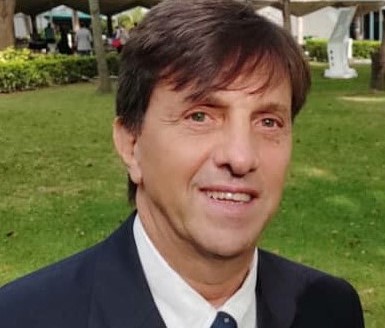
José Luis Jiménez-Figarotti teaches at the Andres Bello Catholic university in Caracas, Venezuela.
He has been involved in virtual exchange/COIL for the past nine years. During his time as virtual exchange coordinator for UCAB, he’s fostered around 300 projects partnering with many different countries around the world.
José Luis has just completed his doctoral thesis in the United States, at Florida Atlantic University. His PhD demonstrates his passion for ‘harnessing virtual exchange for cultural understanding’ in the Venezuelan context.
Before returning to Venezuela, José Luis taught for 20 years in the US. Upon his return, he says he was shocked to be faced with ‘structural violence’ on a scale he had not experienced before.
“That’s what made me start researching these topics. Seeing the reality, whilst at the same time talking about these things and trying to find a way to achieve a reduction in that, was a paradox not lost on me.
I see virtual exchange as a democratic space where all the voices are heard at the same level. But that is not what I was seeing and what the students were experiencing.
An underlying passion for virtual exchange
“When you start seeing students that have been born under a dictatorship, he continues, ‘you realise they don’t understand anything else. As a result, they lack hope for the future. They are depressed. That started me thinking about how to help them and how to design effective strategies using virtual exchange/COIL.”
His initial thinking and research resulted in writing one of the first publications with the Journal of Virtual Exchange. Entitled: The unspoken truth, the article relates to the differences in faculty conditions in different parts of the world, such as those working in war zones like Ukraine or Yemen.
He says that in order to maintain democratic principles, the reality of the socio-political situations of the partnering countries needs to be born in mind during the design phase of the virtual exchange.
New levels of Virtual Exchange
Jose Luis’ recently completed PhD is called: Social Complex Systems in Virtual Third Spaces of Global Education, Sites of Structural Inequalities and Radical Pedagogical Possibilities.
“The third space is based on two different theories; one is Pierre Bourdieu, who talks about the social field, the interactions of the different participants in a social field. And the other is Soja’s theory because he talks about three different spaces of society. The first space is the real space that we live in. The second space is the space that we would like to have, that we aspire to. The first space is this first space where human beings, civilians get together to talk and design ways of finding solutions to overcome those realities that they are living.
So basically, I see virtual exchange as that third space where we put students to work on solutions on the sustainable development goals, for example.”
All his research is based around a number of case studies relating to virtual exchanges and the United Nations Sustainable Development Goals.
The Paradox
This is the point when during his virtual exchanges, José Luis discovers and realises the realities the students were living were invisible. Yet they were completely connected to those same issues that they were discussing.
“Some of my students in Venezuela were living in poverty, and here we are talking about poverty reduction with students from Germany and the US who had little understanding of the reality my students were experiencing!”
One such example involved students in the US and Venezuela collaborating on a project relating to social justice and structural violence. They had to analyse case studies concerning indigenous peoples in Mexico being displaced by industries for example, or Black Lives matter in the US, and the student protests in Venezuela.
José Luis explains how the students were discussing in roundtables about how to find solutions.
“For American students, voting was the solution. But for the Venezuelan students this was immensely frustrating because they were saying, we have voted and voted and voted, and we still have a dictatorship. That’s not a solution of what democracy should be and the living experiences of people who cannot have democracy and cannot have the same strategies to solve the solutions. I named this the ‘clash of habitats’: The understanding of realities and how in that third space you can find solutions with opposing views.”
Things educators should bear in mind when designing a third space in VE
José Luis recommends undertaking deep research in order to gain maximum geopolitical understanding before starting a coil/virtual exchange.
“Do the research on the realities of that country and this is important because I’m adding a new layer on our community.
At the Cyprus conference, most of the educators presented about language and culture, about linguistics. But I say that you need to add this social anthropological layer on collaboration. Culture is good, the language is good, but the understanding of the realities of the other countries are fundamental.”
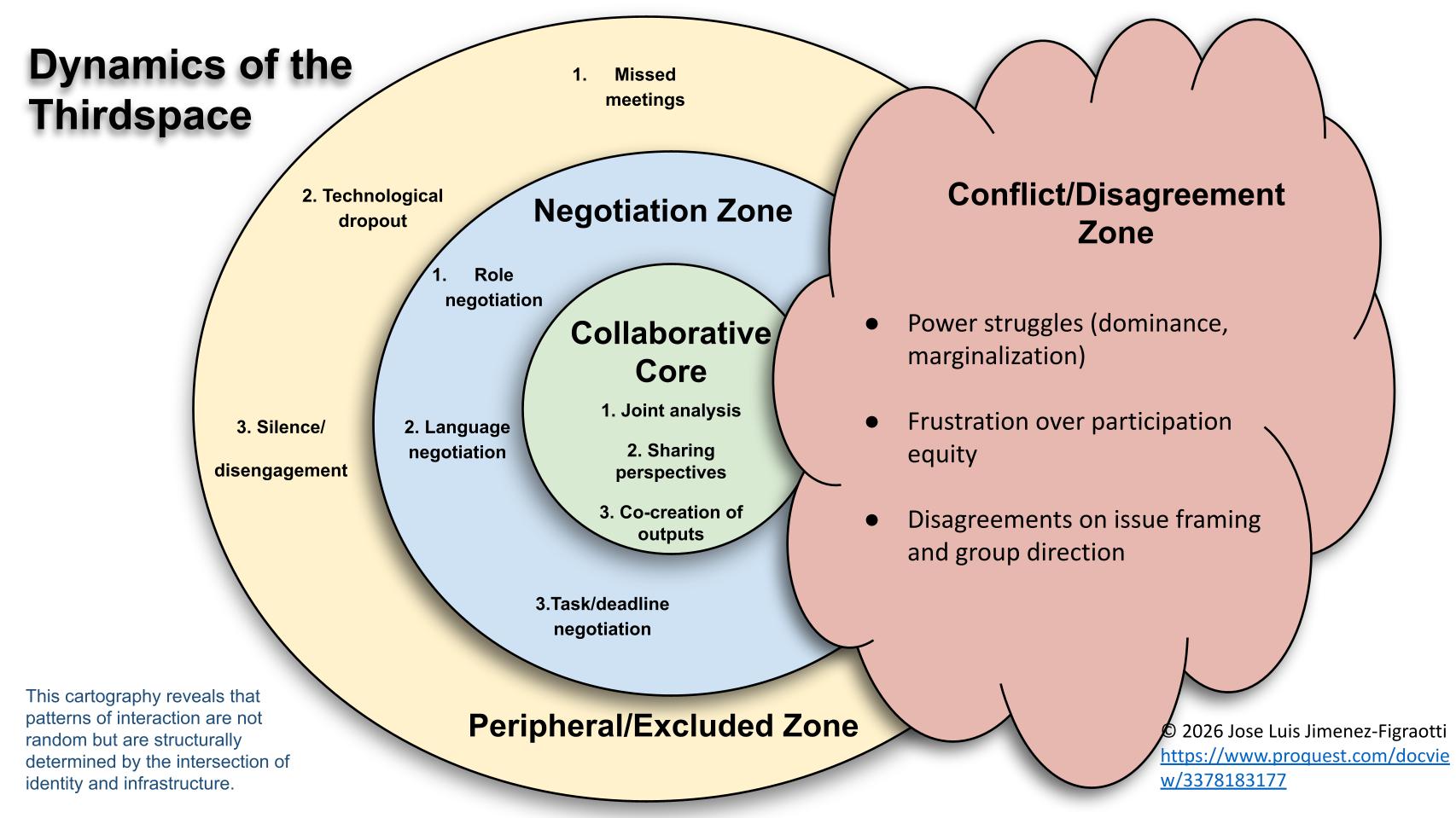
“Mapping the Zones of Interaction“- Through an ethnographic analysis of three case studies, Venezuela-California, Venezuela-Spain, and Venezuela-South Africa, this chapter maps the Virtual Third space as a contested terrain composed of four distinct zones of interaction: the Conflict/Disagreement Zone, the Negotiation Zone, the Collaborative Core, and the Peripheral/Excluded Zone. These zones are fluid and overlapping, reflecting the dynamic and often volatile nature of digital collaboration. The Collaborative Core, where students engaged in joint tasks; the Negotiation Zone, utilized for discussing roles and language; the Conflict/Disagreement Zone, where power struggles surfaced; and the Peripheral/Excluded Zone, where participants disengaged due to insurmountable barriers.
It’s personal
“For me,’ he says, ‘this was not just doing a dissertation to get a degree, but I really, because of my age too, wanted to provide a contribution to our community. In the different chapters, I use case studies to illustrate each of these points. In this way, readers can take into consideration these aspects before embarking on a virtual exchange.
One of the findings in all the case studies that he uses, the primary and the secondary case studies reveal the fundamental attribution error. This is important to bring into the discussion. In this case, it’s about water.
“That is one of the topics that I mention in the dissertation. In Venezuela, we simply don’t have clean water every day. It’s controlled by the dictatorship.
This means we don’t know what day we will get clean water. The result is that if you schedule a Zoom meeting with another country, and right at that moment, water starts pouring – the students have to stop the Zoom and rush to gather water for the whole week – for drinking, for washing, for everything.”
The importance of anthropological realities in virtual exchange
José Luis says this is why it’s anthropological, due to the biological needs of the human being connected to the data and the Zoom meeting.
“What I found is that, students from Europe or students from the United States get very frustrated when that occurs. This is because they don’t understand what is going on. And the fundamental attribution error is that they say the Venezuelan students are lazy and not committed. The result is often that they do not want to work with us as they are not understanding the biological need and are associating it to the social stigma. And that stigma is laziness.”
He says this sort of thing happens a lot during virtual exchanges. Therefore, in his dissertation he aims to bring this new anthropological layer to his community in order to better understand the different realities people across the world are living with.
“It’s not only occurring in Venezuela, but in different countries such as Ukraine when people hear the sirens going to alert people to a bomb threat.”
He says even in the most developed countries, there are struggling communities. For example, in New York and the African American communities and how they face the same struggles like in South America, or South Africa, or in a country at war.
“That’s why I talk about complex systems. It’s not that simple. Many factors contribute to this third space relationship.”